Two Queues, One Counter: The Parcel Pickup Economy Comes to UK Coffee Bars
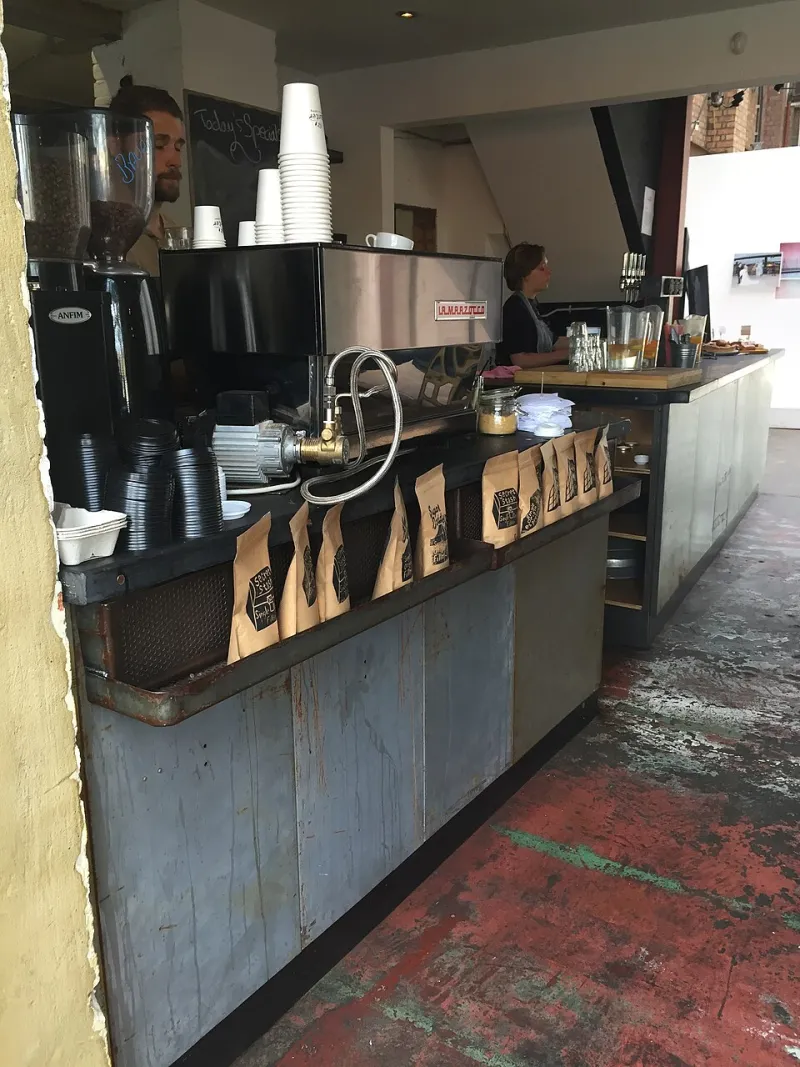
Photo: Bex Walton from London, England, CC BY 2.0, via Wikimedia Commons
There is a sound that now arrives before the grinder in some UK cafés: the soft double beep of a barcode scanner. A customer walks in with a phone in one hand and a returns bag in the other, waits for the barista to point the handheld reader at the label, and leaves with a flat white and a proof of postage. It is not the café you pictured when you started caring about single-origin beans. It is, increasingly, the café that helps pay for them.
Parcel drop-off points, click-and-collect counters and neighbourhood service desks have been migrating into coffee bars for years. The logic is simple enough. High streets have empty units and cautious landlords; parcel networks need local hands; cafés need revenue that does not depend on a second flat white at 3pm. On paper, everyone wins. In practice, the arrangement asks a very particular question of a coffee bar: can you take the parcel money without letting the parcel queue eat the room?
The margin is in the scan, not the shot
The first thing to understand is that the parcel counter is rarely a jackpot. The fee per parcel is usually modest, and a café handling a few dozen collections a day is not suddenly going to retire on barcode commissions. The value is cumulative. A parcel point brings people through the door who might not otherwise have come in, and it gives locals a reason to treat the café as part of their weekly routine rather than a weekend treat.
That matters in a year when rent, rates, energy and staff costs are still doing their own version of a cost-of-living tour. A coffee bar that can add a small, predictable income stream without turning the room into a depot has found something useful. But the economics only work if the parcel job fits the layout. If it slows down the coffee queue, distracts the barista and sends regulars looking for a calmer seat, the café is effectively paying for footfall with its atmosphere.
Footfall is not the same as hospitality
A parcel customer is not a lingerer. They arrive with a task and a time limit. They want a scan, a receipt and a quick exit. That is fine — until their quick exit meets a coffee queue that is trying to be a coffee queue. Two lines form, one for people who want to talk about tasting notes and one for people who want to hand over a returns bag. The barista becomes a switchboard operator.
This is where the romance of the local café meets the reality of the local post office. The parcel counter can make a café feel useful, which is not a bad thing. But usefulness has a texture. If the scanner sits at the end of the espresso bar, the café starts to feel like a sorting office with a milk steamer. If the parcel queue blocks the pastry case, the morning rush becomes a relay race. The room tells customers what it is for, and customers believe it.
The seating tells the story
Seats are not neutral. A collection point near the window can read as a service desk. A scanner on the main bar can read as chaos. Regulars are quick to notice which cafés have become a place to sit and which have become a place to pass through. The laptop crowd, the pram crowd and the Saturday catch-up crowd all make decisions based on that reading.
There is also the small matter of space. Parcel bags, returns sacks and collection shelves take room. In a compact UK coffee bar, a shelf for parcels can mean one fewer table for people. That is a trade, not a tragedy, but it should be a deliberate one. The cafés that make it work tend to give the parcel job its own zone: a dedicated shelf, a clear sign, a small counter away from the espresso machine. The coffee bar stays the coffee bar. The parcel point becomes the front porch.
Making the extra footfall behave
The operational fixes are not glamorous, but they are effective. Separate the queues. Put the parcel scan somewhere that does not interrupt milk steaming. Give staff a script for the awkward moments — the customer who arrives at the coffee till with a parcel, the regular who cannot find the collection shelf, the person who assumes every member of staff can stop what they are doing to find a missing label. Train one person on parcels during peak hours, or move collections to quieter windows. None of this is exciting. All of it protects the product.
The sharper question is which parcel networks a café says yes to. Not every contract is worth the shelf space. Some bring volume and little else; others bring the kind of local footfall that actually converts into coffee. A café can choose which jobs it takes. It can decide that parcels are collected until 4pm, not during the morning rush. It can bundle a collection with a discounted filter coffee, or keep the collection point strictly separate from the seating area. The point is not to ban the parcel counter. The point is to stop it from becoming the main character.
The specialty question
Specialty coffee is an attention business. The story of the bean, the calibration, the milk texture, the way a barista checks the shot — all of it depends on a certain amount of focus. If the barista is scanning labels between tamping, the coffee can still be good, but the ritual is interrupted. The customer may not mind. The regulars probably will.
For BLK Coffee, the interesting question is not whether parcels belong in cafés. It is how a café can take the parcel money without letting the parcel queue rewrite the room. The answer is not a moral one. It is a design one. Give the parcel job a place, a queue and a time. Protect the bar. Keep the seating for people who are staying. Then let the extra footfall do what footfall should do: pay a few bills, introduce a few neighbours, and leave the espresso machine to get on with the thing it is actually there for.
The parcel counter is not a betrayal of café culture. It is a trade. The cafés that get it right will be the ones that decide what the room is for, then design the parcel job around that answer. The ones that get it wrong will have a queue out the door and a barcode scanner playing second fiddle to the coffee. In 2026, that is the quiet choice facing every UK coffee bar with a spare shelf and a rent bill.